

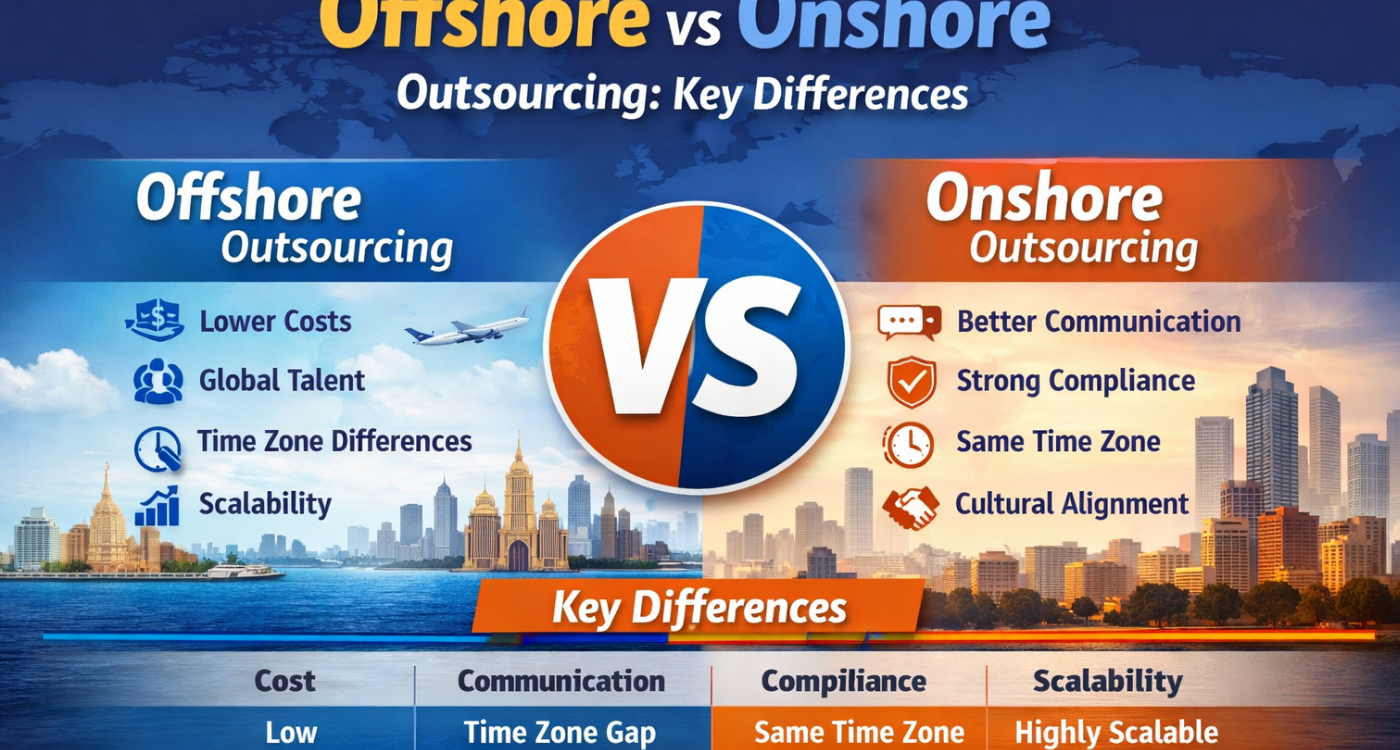

Offshore vs Onshore Outsourcing: Key Differences
In today’s globalized business environment, outsourcing has become a strategic tool for companies looking to reduce costs, improve efficiency, and focus on core activities. Two of the most common outsourcing models are offshore outsourcing and onshore outsourcing. While both offer distinct advantages, choosing the right model depends on your business goals, budget, and operational needs.
This article explains the key differences between offshore and onshore outsourcing, along with their benefits, challenges, and how to decide which option is best for your business.
What Is Onshore Outsourcing?
Onshore outsourcing (also called domestic outsourcing) refers to hiring a third-party service provider within the same country as your business.
Example
An Indian company outsourcing accounting or payroll services to another firm located in Delhi, Mumbai, or Bengaluru.
Key Features
-
Same country and legal system
-
Similar time zones
-
Cultural and language alignment
-
Easier coordination and communication
What Is Offshore Outsourcing?
Offshore outsourcing involves hiring a service provider located in a different country, often to take advantage of lower labor costs and specialized skills.
Example
A US or UK company outsourcing bookkeeping, IT support, or customer service to India or the Philippines.
Key Features
-
Significant cost savings
-
Access to global talent
-
Time zone differences
-
Cross-border legal and data considerations
Offshore vs Onshore Outsourcing: Key Differences
1. Cost
-
Onshore Outsourcing: Generally more expensive due to higher labor and operational costs.
-
Offshore Outsourcing: More cost-effective, often reducing expenses by 40–70%.
Winner: Offshore outsourcing
2. Communication & Time Zone
-
Onshore: Minimal time zone issues; faster responses.
-
Offshore: Time zone differences may cause delays, but can also enable 24/7 operations.
Winner: Onshore outsourcing
3. Quality & Expertise
-
Onshore: Better understanding of local regulations, compliance, and market conditions.
-
Offshore: Access to skilled professionals, especially in IT, accounting, and back-office services.
Winner: Depends on service type
4. Data Security & Compliance
-
Onshore: Stronger alignment with domestic data protection and compliance laws.
-
Offshore: Requires robust contracts, NDAs, and cybersecurity measures.
Winner: Onshore outsourcing
5. Cultural & Language Compatibility
-
Onshore: Fewer cultural gaps and clearer communication.
-
Offshore: Cultural differences may exist, but many offshore providers are trained for global clients.
Winner: Onshore outsourcing
6. Scalability & Flexibility
-
Onshore: Limited scalability due to higher costs.
-
Offshore: Highly scalable with faster team expansion.
Winner: Offshore outsourcing
Pros and Cons Summary
Onshore Outsourcing – Pros
✔ Better communication
✔ Easier compliance management
✔ Higher data security
✔ Cultural alignment
Onshore Outsourcing – Cons
✖ Higher costs
✖ Limited scalability
Offshore Outsourcing – Pros
✔ Lower costs
✔ Access to skilled global talent
✔ High scalability
✔ 24/7 operations
Offshore Outsourcing – Cons
✖ Time zone challenges
✖ Data security concerns if not managed properly
✖ Cultural differences
Which Outsourcing Model Is Right for Your Business?
Choose Onshore Outsourcing if:
-
Compliance and data security are top priorities
-
You require frequent interaction
-
Budget is less restrictive
Choose Offshore Outsourcing if:
-
Cost efficiency is critical
-
You need scalable support
-
You are comfortable managing remote teams
Many businesses today adopt a hybrid model, combining onshore oversight with offshore execution to get the best of both worlds.
Conclusion
Both offshore and onshore outsourcing offer unique advantages. There is no one-size-fits-all solution. The right choice depends on your business objectives, risk tolerance, budget, and service requirements. By understanding the key differences, businesses can make informed decisions and leverage outsourcing as a powerful growth strategy.